Why Classifying Branded Tech Gifts as Marketing Spend Creates a Bribery Act Blind Spot
Most UK procurement teams categorise branded corporate tech gifts under marketing budgets rather than gifts and hospitality. This internal classification decision bypasses the timing and recipient-role checks that the Bribery Act 2010 actually requires.
Published by BritTech Works Team
There is a structural assumption embedded in most UK corporate gifting programmes that rarely surfaces in compliance reviews: the belief that a branded gift is categorically different from an unbranded one for the purposes of the Bribery Act 2010. The logic runs like this — if a power bank carries the company logo, it is a promotional item, not a gift. Promotional items belong in the marketing budget. Marketing spend has its own approval process, which typically does not include the same recipient-role checks or timing restrictions that a gifts and hospitality policy would require. The gift moves through the organisation under a different classification, and the compliance controls that should apply to it are never triggered.
This misclassification is not deliberate evasion. It emerges from how internal budgets are structured and how approval categories have evolved over time. Marketing teams commission branded merchandise. Procurement teams manage supplier relationships. When a marketing team orders five hundred branded wireless chargers to be distributed to key clients, the transaction looks, from a budget perspective, like a marketing campaign. The fact that some of those chargers will be given to procurement managers at client organisations who are currently evaluating contract renewals is not visible at the point of approval, because the approval process does not ask that question.
The Bribery Act 2010 does not distinguish between branded and unbranded gifts in its assessment of compliance risk. The relevant test is whether the gift could improperly influence the performance of a relevant function — and the presence of a company logo does not alter that analysis. A branded wireless charging station given to a procurement director during an active tender evaluation carries the same risk profile as an unbranded one. The Ministry of Justice guidance is explicit that the purpose and timing of a gift, and the role of the recipient at the time it is given, are the primary factors in assessing whether adequate procedures have been followed. Internal budget classification is not part of that assessment.
In practice, this is where corporate tech gifting decisions start to create compliance exposure that no one inside the organisation has identified. The gifts and hospitality register — which most companies maintain as part of their adequate procedures documentation — does not capture branded merchandise distributed through marketing channels, because those items were never classified as gifts in the first place. If the Serious Fraud Office were to examine the organisation's gifting practices, the absence of those items from the register would not demonstrate compliance. It would demonstrate a gap in the monitoring process.
The timing dimension compounds this problem in a specific way. Most organisations have internal rules about not giving gifts to counterparties during active procurement processes. Those rules apply to the gifts and hospitality budget. They do not automatically apply to marketing merchandise, because the two categories are managed separately. A relationship manager who knows that a client is currently evaluating three competing suppliers might correctly refrain from sending a personal gift. The same relationship manager might simultaneously approve the distribution of branded tech accessories to that client's team as part of a marketing campaign, without recognising that the two situations are legally equivalent from the Act's perspective.
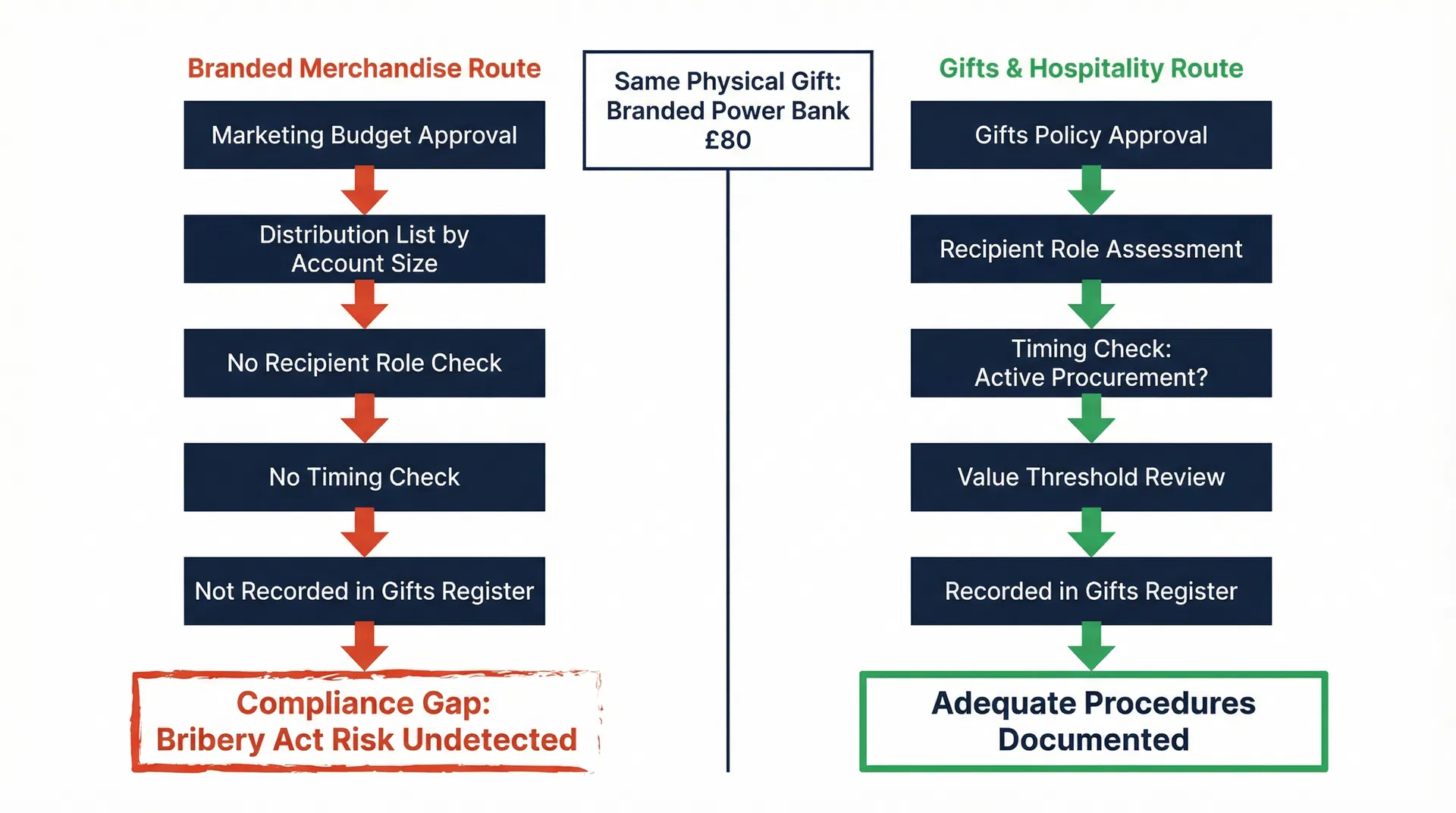
The recipient role variable is the element most consistently absent from how branded merchandise programmes are designed. When a marketing team commissions a batch of branded power banks, the distribution list is typically built around relationship tiers or account size — not around whether specific recipients are currently in a decision-making role with respect to the gifting organisation. A procurement manager and a communications manager at the same client organisation may receive identical items, but their compliance risk profiles are entirely different. The procurement manager's receipt of a tech gift during a contract evaluation period is a materially different event from the communications manager receiving the same item.
The practical consequence of this misclassification is that organisations end up with compliance documentation that is internally consistent but structurally incomplete. The gifts and hospitality register shows no problematic entries because the problematic entries were never recorded there. The marketing spend records show a series of merchandise distributions that look entirely routine. Neither record, examined in isolation, reveals the issue. The gap only becomes visible when someone asks whether any of the recipients of branded merchandise were, at the time of receipt, in a procurement or decision-making role with respect to the organisation that gave the gift.
Understanding how internal gift classification interacts with compliance obligations is one of the dimensions that sits beneath the broader question of how different gift categories serve different business objectives. The category decision and the compliance classification decision are related but distinct, and organisations that resolve one without examining the other are likely to find that their gifting programme is more exposed than their documentation suggests.
The adequate procedures defence under the Act requires demonstrable implementation, not just documentation. A gifts policy that covers hospitality spend but does not extend to branded merchandise distributed through marketing channels is a policy with a structural gap. Closing that gap does not require a fundamental redesign of how gifting programmes operate. It requires asking, at the point of distribution approval, whether any recipients are currently in a role that creates compliance risk — and routing those cases through the same review process that would apply to any other gift of equivalent value.