Why Choosing a Corporate Gift Based on the Occasion Misses the Point Entirely
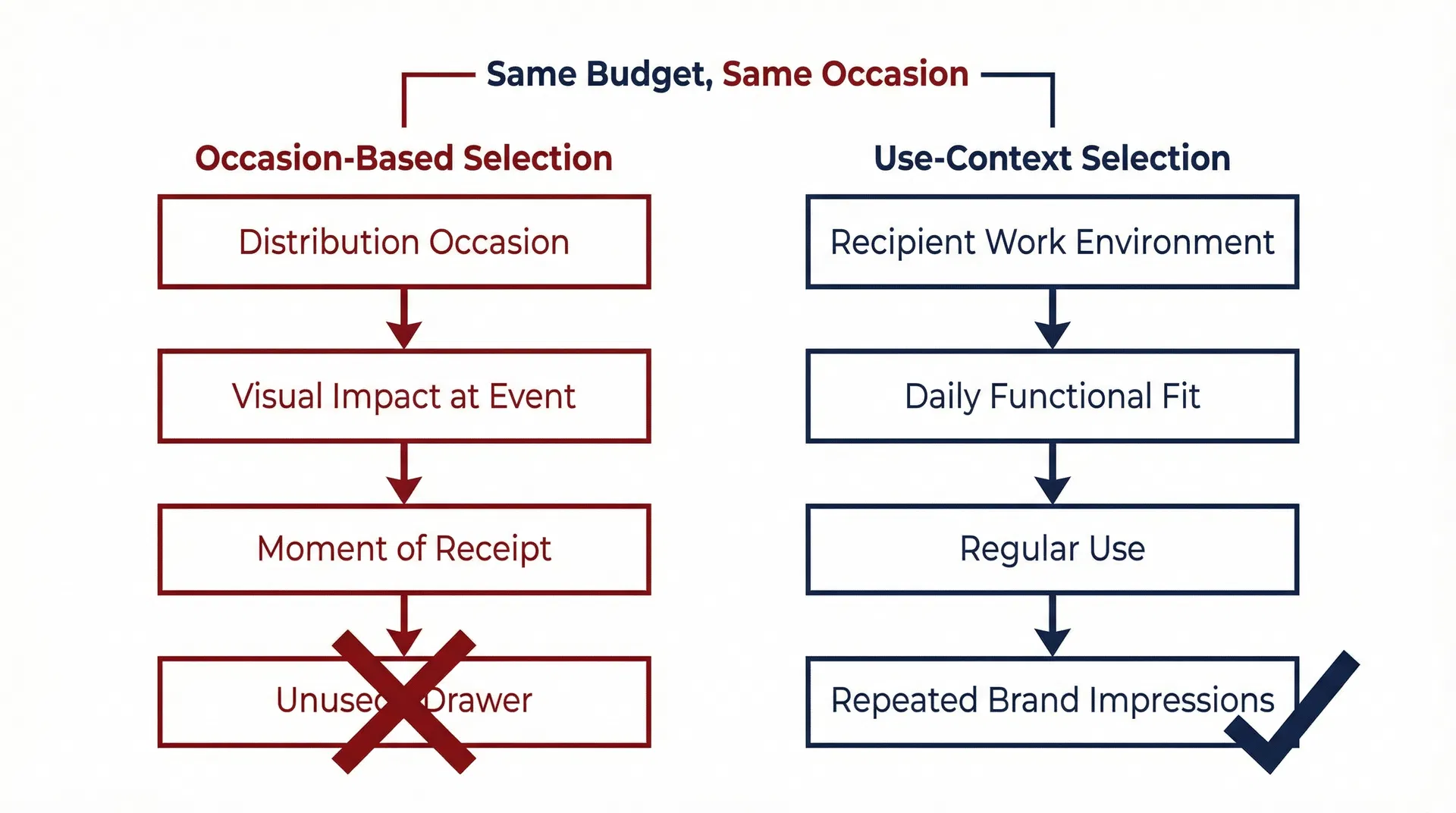
Most procurement teams select corporate gifts based on the distribution occasion. The problem is that the occasion ends within hours. The gift does not — and whether it gets used depends entirely on the recipient's daily working context, not on what the event was.
Published by BritTech Works Team
There is a persistent logic in corporate gift procurement that goes something like this: identify the occasion, match the gift to the occasion, and the decision is made. A product launch calls for something celebratory. An annual conference calls for something branded and practical. A client appreciation event calls for something premium. The occasion provides the frame, and the gift fills it. This logic feels coherent because it produces decisions quickly and gives procurement teams a defensible rationale when questioned about their choices.
The problem is that the occasion ends within hours. The gift does not.
When a branded power bank is handed to a delegate at a conference, the moment of receipt lasts perhaps thirty seconds. The delegate places it in a bag, returns to their seat, and the event continues. What happens to that power bank over the following weeks and months is entirely disconnected from the conference itself. Whether it gets used daily, placed in a drawer, or discarded depends not on what the occasion was, but on whether the product fits the recipient's actual working life. A delegate who travels frequently and works from multiple locations will use a compact, high-capacity power bank every week. A delegate who works from a fixed desk with permanent charging access will use it almost never. The occasion told the procurement team nothing about this distinction. The occasion was the same for both recipients.
This is where the decision starts to be misjudged. Procurement teams that organise their gift selection around the occasion are effectively optimising for the moment of receipt rather than for the period of use. They are making a decision that will be evaluated by the recipient over months, based on a frame that expires in an afternoon. The gift that feels right for a product launch — something with visual impact, something that photographs well on a table display — is not necessarily the gift that will be used, remembered, or associated with the brand six months later.
The misalignment becomes more pronounced with tech gifts specifically because tech products have functional prerequisites that most other gift categories do not. A branded notebook works regardless of where the recipient sits or how they work. A branded wireless charger only works if the recipient has a Qi-compatible device, uses it on a surface where wireless charging is practical, and has a reason to charge at that location rather than using a cable. These are not obscure requirements. But they are requirements that a procurement team focused on the occasion — "this is a client appreciation event, so we want something premium and tech-forward" — will not have thought through, because the occasion framing does not prompt those questions.
The consequence of this gap is a pattern that most experienced procurement professionals will recognise, even if they have not named it explicitly. A significant portion of branded tech gifts distributed at events end up unused not because the product was poor quality, but because it did not fit the recipient's context. The procurement team selected a gift that was appropriate for the occasion. The recipient received a gift that was irrelevant to their daily life. Both things can be true simultaneously, and the occasion-based selection logic is what allows that outcome to persist without being identified as a systematic error.
The correction requires a shift in the question being asked at the point of selection. Instead of "what gift suits this occasion," the more productive question is "what does the daily working environment of our recipient group actually look like, and which product category would integrate into that environment without friction." For a client base that is predominantly mobile — field sales teams, consultants, executives who travel between offices — a compact power bank with a high charge capacity addresses a real and recurring problem. For a client base that is predominantly office-based, a wireless charging pad that sits on a desk provides visible, daily utility. The occasion may be identical in both cases. The right gift category is not.
This is the dimension that most standard gift selection frameworks do not address clearly. The frameworks tend to organise choices around occasion type, recipient seniority, or budget tier — all of which are useful inputs, but none of which capture the post-occasion use context. Understanding how different business needs and recipient profiles should shape the gift category decision, rather than how the occasion should shape it, is what separates procurement that produces lasting brand presence from procurement that produces a table display that gets photographed and forgotten.
There is also a compounding effect that procurement teams rarely account for. When a branded tech gift is used regularly, it generates repeated brand impressions over an extended period — every time the recipient charges their phone at a meeting, every time they reach for the power bank before a flight. When the same gift sits unused, it generates zero impressions after the initial receipt. The ROI calculation for corporate gifting is therefore not primarily about the cost of the gift relative to the value of the occasion. It is about the cost of the gift relative to the number of genuine use occasions it will create over its lifetime. A gift that costs thirty percent more but gets used fifty times generates a fundamentally different return than a gift that costs thirty percent less and gets used twice.
The occasion will always be part of the context for a corporate gift decision. But treating it as the primary selection criterion produces a category of error that is entirely avoidable — and that compounds quietly across every gifting cycle until someone asks why the branded items from last year's conference are still sitting in recipients' desk drawers.