Why the Lead Time on Your Custom Tech Gift Quote Starts Later Than You Think
Most procurement teams calculate their order deadline by subtracting the supplier's quoted lead time from the event date. For custom tech gifts, this calculation is almost always wrong by two to three weeks — because the quoted figure doesn't include artwork approval, sample confirmation, or compliance verification.
Published by BritTech Works Editorial
Most procurement teams calculate their order deadline by subtracting the supplier's quoted lead time from the event date. For custom tech gifts — branded power banks, wireless chargers, USB hubs — this calculation is almost always wrong by two to three weeks. The error is not carelessness. It is a structural misread of what the supplier's quoted figure actually represents.
When a supplier quotes "10 to 12 working days," that figure refers to the production-to-despatch window. It starts from the moment artwork is formally approved and the order is confirmed. It does not include the time required to reach that approval point. For standard branded merchandise — a pen with a logo, a tote bag with a single-colour print — the gap between order placement and artwork approval is often small enough to be negligible. A buyer submits a logo file, the supplier generates a proof, the buyer approves it the same day, and production begins. The quoted lead time and the practical lead time are close enough that conflating them causes no real harm.
Custom tech gifts operate differently. The artwork approval process for a branded power bank or wireless charger is not a single-step logo placement exercise. It involves confirming the print area dimensions on a three-dimensional surface, agreeing on Pantone colour references for the housing, reviewing a physical or digital sample of the branding position, and — in many cases — approving a pre-production functional sample to verify that the unit performs to specification. Each of these steps has its own elapsed time, and each step depends on the previous one being resolved first. A buyer who submits artwork on Monday should not expect approval to be complete before the following week at the earliest, and that is assuming no revision cycles.
In practice, this is often where the timeline starts to collapse. The procurement team receives a quote that says "10 to 12 working days" and builds their order deadline around that figure. They place the order with what they believe is sufficient lead time. What they have not accounted for is that the clock on those 10 to 12 days has not yet started. The artwork approval process — which can itself take five to ten working days for a custom tech product — sits entirely outside the quoted figure.
The confusion is compounded by how suppliers communicate during the early stages of an order. When a buyer places an order and submits initial artwork, the supplier will typically confirm receipt and begin the proofing process. From the buyer's perspective, the order is "in." From the supplier's perspective, production has not started and will not start until the approval chain is complete. There is no deception in this — it reflects the genuine structure of the manufacturing process. But the gap between those two interpretations is where deadlines are lost.
There is a further complication specific to custom tech gifts that does not apply to most branded merchandise categories. For items like power banks and wireless chargers, the product itself must meet UK and EU technical standards — CE marking, UKCA certification, battery safety requirements. If a buyer requests a specification change during the approval process — a different battery capacity, a change in the USB port configuration, a different housing material — the supplier may need to revert to a certified variant or re-evaluate the compliance status of the modified product. This is not a bureaucratic delay. It is a genuine constraint that cannot be bypassed. But it adds time to the approval process that most procurement teams have not budgeted for, because they are thinking about the order as a branding exercise rather than as a product specification exercise.
The practical consequence of this miscalculation is predictable. A procurement team that believes they have placed an order with three weeks to spare discovers, ten days before the event, that artwork approval is still in progress and production has not started. At that point, the options narrow quickly. The buyer can accept a standard stock product with minimal customisation, losing the differentiation they had planned for. They can pay a significant premium for air freight on a compressed production schedule, which may or may not be achievable depending on the supplier's current capacity. Or they can accept that the gifts will not arrive in time and manage the consequences of that outcome.
The decision about which type of corporate gift best serves a particular business need — explored in more detail in our guide to corporate gift selection for different business contexts — cannot be made in isolation from the time constraints of the procurement cycle. A custom tech gift that would have been the right choice with six weeks of lead time becomes the wrong choice with two weeks remaining, not because the product itself has changed, but because the conditions under which it can be delivered have changed.
The correction to this problem is not complicated, but it requires procurement teams to ask a different question when they receive a supplier quote. Instead of asking "what is your lead time," the more useful question is "when does your quoted lead time begin, and what needs to happen before that clock starts." For custom tech gifts, the answer to that question will almost always reveal a gap of two to three weeks that was not visible in the original quote. Building the order deadline around the full elapsed time — including artwork approval, sample confirmation, and any compliance verification — rather than around the production window alone, is the only way to avoid the situation that most procurement teams encounter at least once before they learn to ask the question differently.
---
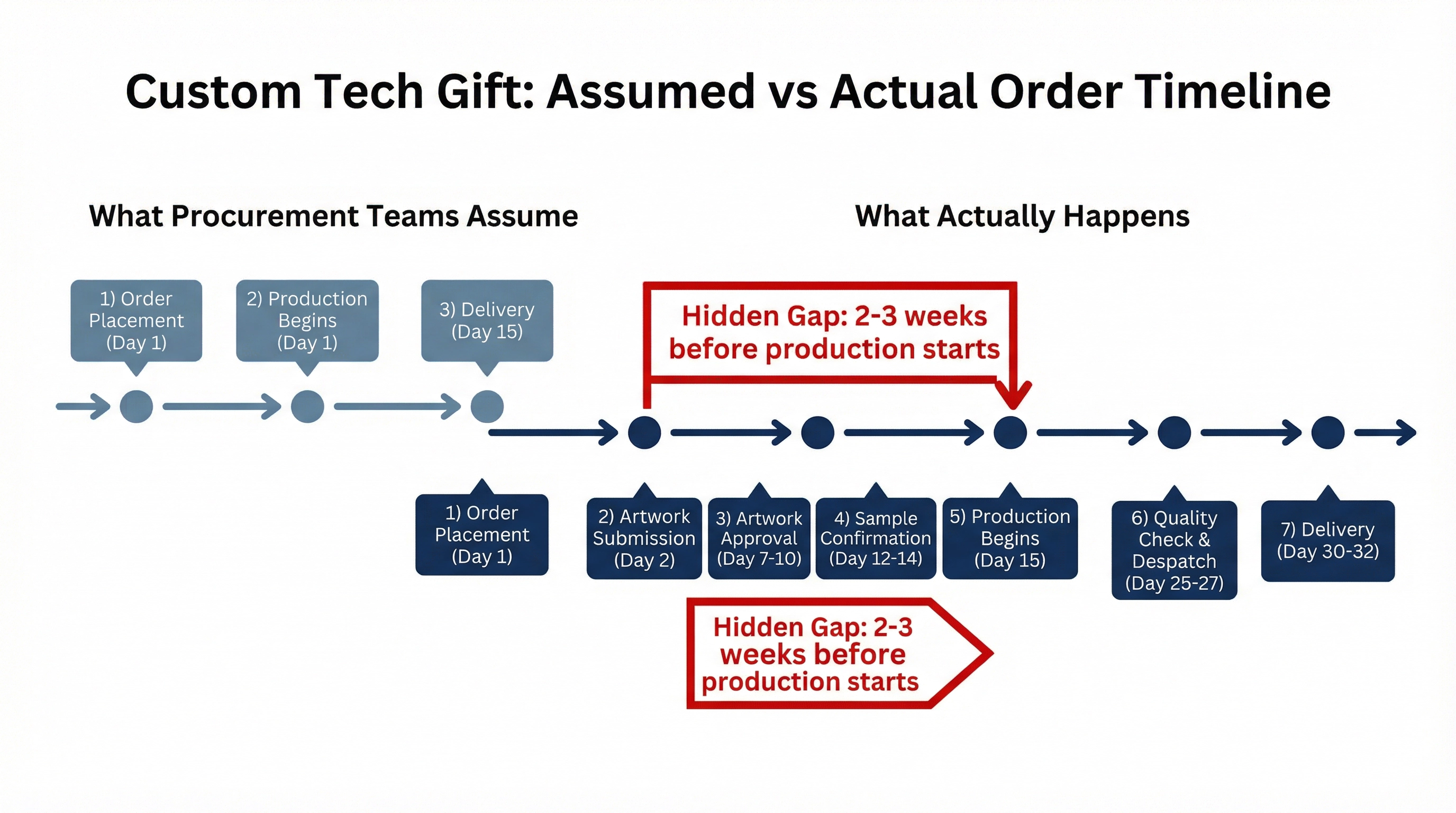
*The gap between when a buyer believes production starts and when it actually starts is the primary source of deadline failures in custom tech gift procurement.*