Why a Generic Certificate Can Approve the Wrong Branded Power Bank: A UK Bulk-Order Documentation Check
A UK B2B procurement guide to checking that branded power-bank declarations, technical evidence, battery-transport records and supply-chain roles actually match the final bulk-order model.
Published by BritTech Works Team
A generic certificate is not enough to approve a branded power bank for a UK bulk order when it cannot be connected to the exact finished model, battery configuration, intended market and party placing it on that market. The team needs to trace the ordered item to its declaration, model identifiers, safety evidence and transport information. A power bank combines a battery, electronics, branding and a distribution route; those elements need different documents.
In practice, this is often where branded power bank decisions start to be misjudged. A buyer asks for “the certificate” after selecting capacity, approving a logo position and confirming quantity. The supplier then supplies a document carrying a similar product description, a test report for a component, or a declaration that cannot be matched to the finished SKU. The document may be real, but that does not make it useful evidence for the goods about to be branded and delivered. The error is not always a deliberate misrepresentation. More often, the team has treated documentation as a single administrative item instead of a controlled chain of evidence with several distinct purposes.
The first control is model identity. The ordered product needs a stable description that both sides use in the same way: the power bank model or type, rated capacity and watt-hours, input and output arrangement, battery cell or pack configuration where relevant, revision, and any safety-relevant variation. Artwork is not normally proof of a changed electrical design, but a supplier substitution, a revised battery pack, a changed charging board, a different enclosure or a revised factory configuration can create a gap between an earlier document set and the item finally supplied. If the purchase order says only “10,000 mAh branded power bank”, there may be no reliable way to determine which of several similar variants the approval evidence applies to.
A declaration of conformity and a test report should not be collapsed into the same idea. The UK government’s guidance on placing UKCA or CE marked products on the market in Great Britain describes product marking as part of a broader process involving the correct market, applicable rules, conformity assessment, documentation and continuing compliance. It also explains that the technical file commonly contains material such as test reports, design information and risk assessments, while a declaration identifies the product and the basis on which conformity is declared. A report can be an important part of the evidence. It is not automatically a declaration for the finished model, and a declaration is not a universal independent safety certificate.
What remains invisible is that a power bank may sit across several regulatory and operational questions. The Electrical Equipment (Safety) Regulations 2016 have their own voltage scope and exclusions, so a buyer should not claim that those Regulations alone govern every power bank simply because the item is electrical. At the same time, an item outside one instrument’s scope is not automatically free of other product, battery, waste, consumer-information or transport requirements. The GB electrical-equipment guidance is useful precisely because it separates legal roles, technical documentation, declarations, markings and traceability rather than treating a familiar logo as the entire compliance process.
The supply-chain role should be identified before the purchase order promises who will carry the documentation responsibility. Under the GB guidance, a manufacturer can be the business that has a product designed or made and then markets it under its own name or trademark. An importer is a UK-established business placing a product from outside the UK on the market. The legal outcome depends on the actual arrangement, product rules and route, but a branded buyer cannot safely assume that all obligations remain with the factory merely because the factory made the physical item. The arrangement can change further if a party modifies the item in a way that affects conformity or markets it under its own name.
This does not mean that every corporate-gift buyer should demand a supplier’s complete technical file or attempt to make a legal determination alone. Technical files can contain commercially sensitive material, and the formal evidence that must be held, disclosed or retained varies with the applicable rule and role. The procurement decision is narrower: identify who is taking each responsibility, ask for the product-specific evidence appropriate to that role, and record the answer before the product is approved. If a supplier says that it will act as manufacturer or importer for the route, the order file should make that statement traceable rather than leaving it as a sales assumption.
A generic PDF is least reliable when it is detached from the final configuration. A document for a 5,000 mAh model does not establish the status of a 10,000 mAh version merely because the casing is similar. A report naming one input rating may not describe a revised charging board. A declaration that cannot be linked to a model, type, serial or batch convention is difficult to reconcile when cartons arrive. The check is not about insisting on a marketing name; it is about bridging the commercial name, technical model designation and shipped identifiers.
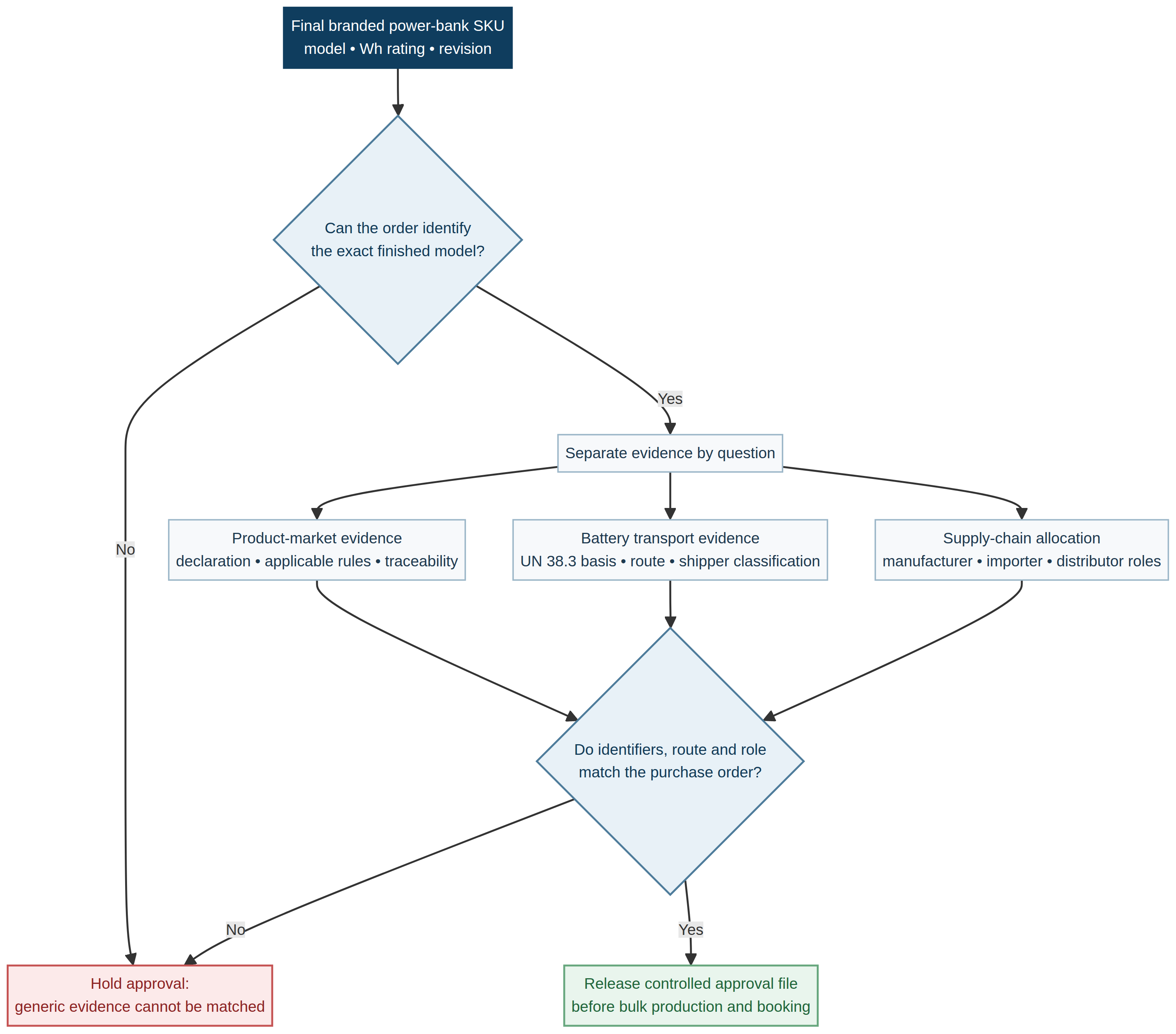
The same distinction applies to transport evidence. A lithium-ion battery means that shipment planning cannot be inferred from product-market documentation. The UK Civil Aviation Authority states that power banks within the relevant air-transport provisions must be of a type that meets the UN Manual of Tests and Criteria, Part III, subsection 38.3. That is a transport-safety test condition, not a general statement that the finished branded item has met every UK product requirement. The CAA also makes clear that dangerous-goods responsibilities involve the parties sending, packing, handling and operating the movement, with classification remaining a shipper responsibility. The CAA’s current power-bank guidance should be treated as route-specific evidence, not a substitute for carrier acceptance or product documentation.
The mistake usually occurs when a buyer hears that a battery has “passed UN 38.3” and treats that phrase as a complete release decision. A test summary or underlying evidence must be linked to the relevant battery type and configuration, but even a correctly linked document does not decide whether a particular carrier, packaging method, state of charge, mode of transport or destination will be accepted. The power-bank delivery route still requires its own decision. Keeping the transport file separate from the market-access file prevents one reassuring document from being used to answer a different question.
The order of decisions matters. Confirm the exact model and its fixed elements, identify the intended market and supply-chain roles, then confirm documents and declarations for that route and final model. Review battery transport evidence against the distribution plan before the programme is released in bulk. When the sequence is reversed, branding and packaging can be approved before the product, documents and delivery method have been shown to describe the same object.
Traceability is the control that turns those separate checks into a usable record. The GB electrical-equipment guidance describes identification and economic-operator information as part of the evidence system, with model, type, batch, serial or other identifying elements allowing equipment to be connected to the manufacturer and importer where applicable. For a corporate gift programme, the buyer should be able to cross-reference the approved quotation, artwork version, supplier model identifier, document references, purchase order and any batch or carton information supplied at dispatch. This becomes more important when a large delivery is split between office locations or individual recipients, because the evidence needs to remain meaningful after the original cartons have been broken down.
A document-control check does not demand one fixed checklist. A domestic office consignment is not the same as an international campaign with individual shipments, variations and external fulfilment. Northern Ireland, EU destinations, Crown Dependencies and overseas territories can have different marking arrangements, while carrier rules vary by mode and route. The mistake is to apply a document intended for one market or role to all cases without checking its scope. “UK” can conceal a distinction that becomes visible only after goods are packed.
The supplier relationship also changes how evidence should be interpreted. A mature supplier may maintain a clear revision history, model codes and a documented substitution process. A less specialised supplier may rely on broadly worded files from a component source or upstream factory. Neither situation can be judged by document appearance alone. The useful question is whether the supplier can explain how the document belongs to the exact model, what configuration it covers and who will maintain the records for the intended route.
The buyer’s internal approval should therefore avoid a binary “certificate received” status. A better record distinguishes product-model evidence, declared market route, economic-operator allocation, transport evidence and shipment traceability. This creates a smaller but more reliable set of approval questions. It also means that a commercial change can be recognised as a control change. A capacity increase, alternative cell source, charging-board revision, different country of first supply, new destination or revised direct-to-home route can be assessed for its effect on the evidence file before it becomes an irreversible production decision.
The procurement consequences are operational rather than theoretical. If a shipment is delayed because a forwarder requests clarification, the team needs to know which party can identify the battery and which document applies. If a distributor or market-surveillance authority requests information, the record must point to the relevant model rather than a folder of loosely similar PDFs. If an issue arises after delivery, the programme owner needs to identify affected stock without reconstructing the decision from email attachments and artwork proofs. Generic paperwork fails at these moments because its connection to the supplied goods was never established.
There is also a reputational effect. A branded power bank carries the commissioning organisation’s identity, so the recipient experiences any failure as part of that organisation’s decision even when the root cause sits upstream. That makes document matching a brand-protection task as well as a compliance task. The broader product-selection framework explains how use case, recipient group and delivery conditions interact with the choice of corporate technology gift; the wider planning logic remains useful once the model has passed its technical and documentation checks.
A generic certificate can still have a legitimate place in a supplier conversation. It may indicate that an upstream product family has been tested, that a component has a known basis, or that a supplier is able to begin a more specific evidence discussion. It becomes unreliable only when it is used as final approval for a branded item whose model, battery configuration, market role or delivery route has changed. The disciplined decision is not to collect more documents than necessary. It is to ensure that each document answers one defined question about the same finished power bank before the bulk order is released.