Why Inferring Tech Gift Specifications from Job Titles Produces Systematically Wrong Outcomes
When procurement teams select corporate tech gift specifications based on recipient seniority rather than actual usage behaviour, they introduce a structural error that compounds across every unit in the order — and the error is invisible until the gifts have already been distributed.
Published by BritTech Works Team
There is a specific assumption embedded in most corporate tech gifting decisions that rarely gets examined: the belief that a recipient's seniority level reliably predicts their technology usage patterns. A C-suite executive, the logic goes, needs a premium wireless charger. A mid-level manager needs a standard power bank. A field sales team needs something durable and portable. This inference feels intuitive because it maps onto familiar procurement categories — and that familiarity is precisely why it persists long after it has stopped producing useful results.
The problem is not that seniority is irrelevant to gift selection. It is that seniority is being used as a proxy for information that can only be obtained through actual observation. A job title tells you something about organisational authority and compensation level. It tells you very little about whether someone already owns three wireless chargers, whether they primarily work from a fixed desk or travel constantly, or whether their devices use USB-C or remain on older charging standards. These are the specifications that determine whether a tech gift becomes a daily-use item or ends up in a drawer within the first week.
In practice, this is where corporate tech gift decisions start to produce systematically wrong outcomes. The inference chain — seniority implies usage context implies appropriate specification — contains a gap at every link. Senior executives in UK organisations are, on average, more likely to have already received premium tech accessories from previous gifting cycles, from their own organisations, or from other business relationships. Giving a high-capacity wireless charging pad to someone who already has two of them does not register as generosity. It registers as a failure to pay attention. The same logic applies in reverse: a mid-level manager who travels three days a week for client meetings has a genuine need for a high-capacity power bank, but if the specification decision was made based on their grade rather than their actual work pattern, they may receive a lower-capacity unit that runs out before their longest travel day ends.
The structural issue is that tech accessories have functional specifications — capacity, charging speed, port compatibility, physical dimensions, weight — that interact directly with the recipient's actual devices and daily routines. Unlike a bottle of wine or a leather notebook, a power bank that does not match someone's usage requirements is not merely less appreciated; it is functionally inadequate. The gap between a 10,000mAh and a 20,000mAh unit is not a matter of perceived luxury. It is a matter of whether the gift can actually charge a MacBook Pro on a long-haul flight. When that specification is chosen based on the recipient's job title rather than their actual device ecosystem, the probability of a functional mismatch is high — and the mismatch is invisible to the person who made the decision.
What makes this pattern particularly persistent is that the feedback loop is broken. When a recipient receives a tech gift with the wrong specification, they rarely communicate that back to the procurement team. They accept the gift, thank the sender appropriately, and the item either gets used occasionally or does not get used at all. The procurement team sees no negative signal. The gifting programme is recorded as successful. The same inference logic is applied to the next cycle, and the same structural mismatch is reproduced at scale.
The alternative is not to conduct detailed surveys of every recipient's device inventory — that creates its own problems around data collection and administrative overhead. The more practical approach is to recognise which specifications are genuinely seniority-dependent and which are not. Aesthetic finish, packaging quality, and brand positioning of the product itself are legitimately influenced by seniority. Functional specifications — capacity, compatibility, form factor — are not. A senior executive and a field sales representative may need the same power bank capacity for entirely different reasons. The decision to differentiate on capacity based on seniority introduces a false variable into a decision that should be driven by use case.
This distinction matters particularly for UK organisations running gifting programmes across mixed recipient groups. The temptation to create a clean tiered structure — premium tier for directors and above, standard tier for managers, basic tier for staff — is understandable from a budget management perspective. But when that tiering is applied to functional specifications rather than just aesthetic quality, it produces a distribution where the people with the most demanding travel schedules may receive the least capable devices, while executives who rarely leave their offices receive high-capacity units they have no occasion to use.
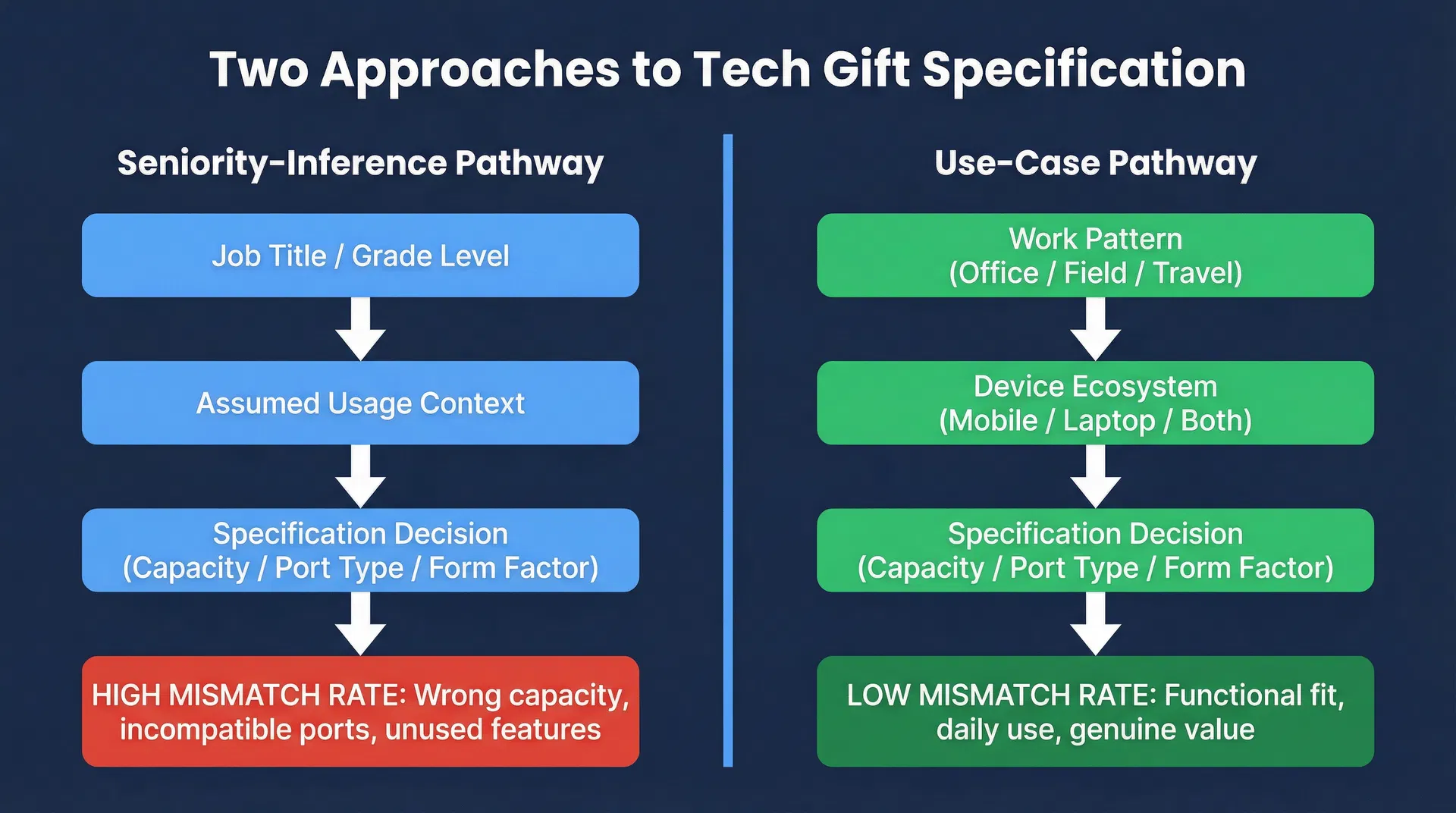
The question worth asking before any tech gifting programme is finalised is not what level of product is appropriate for each seniority tier, but what usage context each recipient group actually operates in. For organisations that have access to basic information about their recipients' roles — whether they are primarily office-based or field-based, whether they travel domestically or internationally, whether they work primarily on mobile devices or laptops — that information is far more useful for specification decisions than job title alone. It does not require a data collection exercise. It requires a different question at the brief stage.
Understanding which specifications actually serve different recipient groups is one of the practical dimensions that sits beneath the broader question of which gift categories align with different business objectives. The category decision and the specification decision are related but distinct. Getting the category right — choosing functional tech accessories over symbolic luxury items — does not automatically produce the right specification. That requires a separate assessment, and one that job title alone cannot reliably support.
The consequence of not making that distinction is a gifting programme that looks coherent on paper — tiered by seniority, differentiated by budget band, delivered on schedule — but produces a distribution of functional mismatches that no one inside the organisation ever sees. The gifts are given, the relationships are maintained at a surface level, and the opportunity to create a genuinely useful touchpoint is quietly lost.