Can You Preload Data onto Branded USB Drives for Corporate Gifts? A UK GDPR and Security Guide
A UK procurement guide to preloading public or personal data onto branded USB drives, covering encryption, removable-media policy, recipient access, version control and UK GDPR security responsibilities.
Published by BritTech Works Team
A company can preload content onto branded USB drives for corporate gifting, but the decision is only defensible when the content, recipient, protection method and device policy have been agreed before production. Public material such as a product catalogue, event presentation or approved brand assets is operationally different from customer records, employee information, contact lists or any file containing personal data. Once a USB drive carries personal information, it is no longer just a promotional product; it becomes a removable-media method of data storage and distribution.
This distinction is where many corporate gift orders begin to go wrong. A procurement brief often contains a line such as “preload the latest company information on every USB drive”. The supplier interprets that as a file-copying task, while marketing treats it as a useful extension of the branded packaging. Neither interpretation answers the more important questions: what information is being copied, who is authorised to receive it, whether the recipient is expected to connect the device to a work computer, and what happens when the file becomes outdated or the drive is lost.
For a UK business, the safest starting point is to classify the proposed content before selecting the USB drive. Public corporate material can usually be distributed as a communications asset if it has been approved for external circulation and does not contain hidden metadata, tracked personal information or internal-only attachments. A presentation that has been cleared for a public event is not automatically safe simply because it is stored as a PDF. Speaker notes, document properties, embedded spreadsheets and linked files can carry information that was never intended to leave the organisation.
Personal data requires a different decision path. The ICO’s guidance on encryption and data storage specifically identifies USB and backup media as places where personal information may be stored and explains that encryption can protect against unauthorised or unlawful processing, particularly when a device is lost or stolen. That does not mean that encryption alone makes every preloaded gift appropriate. It means the business should treat protection as part of the data-handling decision rather than as a cosmetic feature to be added after the USB model has already been chosen.
The practical mistake is to approve the USB shape, memory capacity and logo artwork first, then ask the supplier whether it can preload a file. By that stage, the order may already be built around a standard, unencrypted promotional drive intended for casual file transfer. If the information later turns out to require restricted access, password protection, read-only behaviour or a controlled key-management process, the original product may be unsuitable. Changing the specification can affect the firmware, testing, unit cost, minimum order quantity and production schedule.
Preloading public content still requires discipline. The procurement team should provide a release-controlled package rather than a folder assembled informally by several departments. The package should have an owner, an approval date and a defined version. It should also be checked for hidden personal data, document comments, tracked changes, embedded links and files that can change after delivery. A branded USB drive distributed at an event may remain in circulation for years, so “current at the time of the event” is not the same as “safe to rely on after the event”.
The distinction between a storage gift and a data-delivery device is also important.
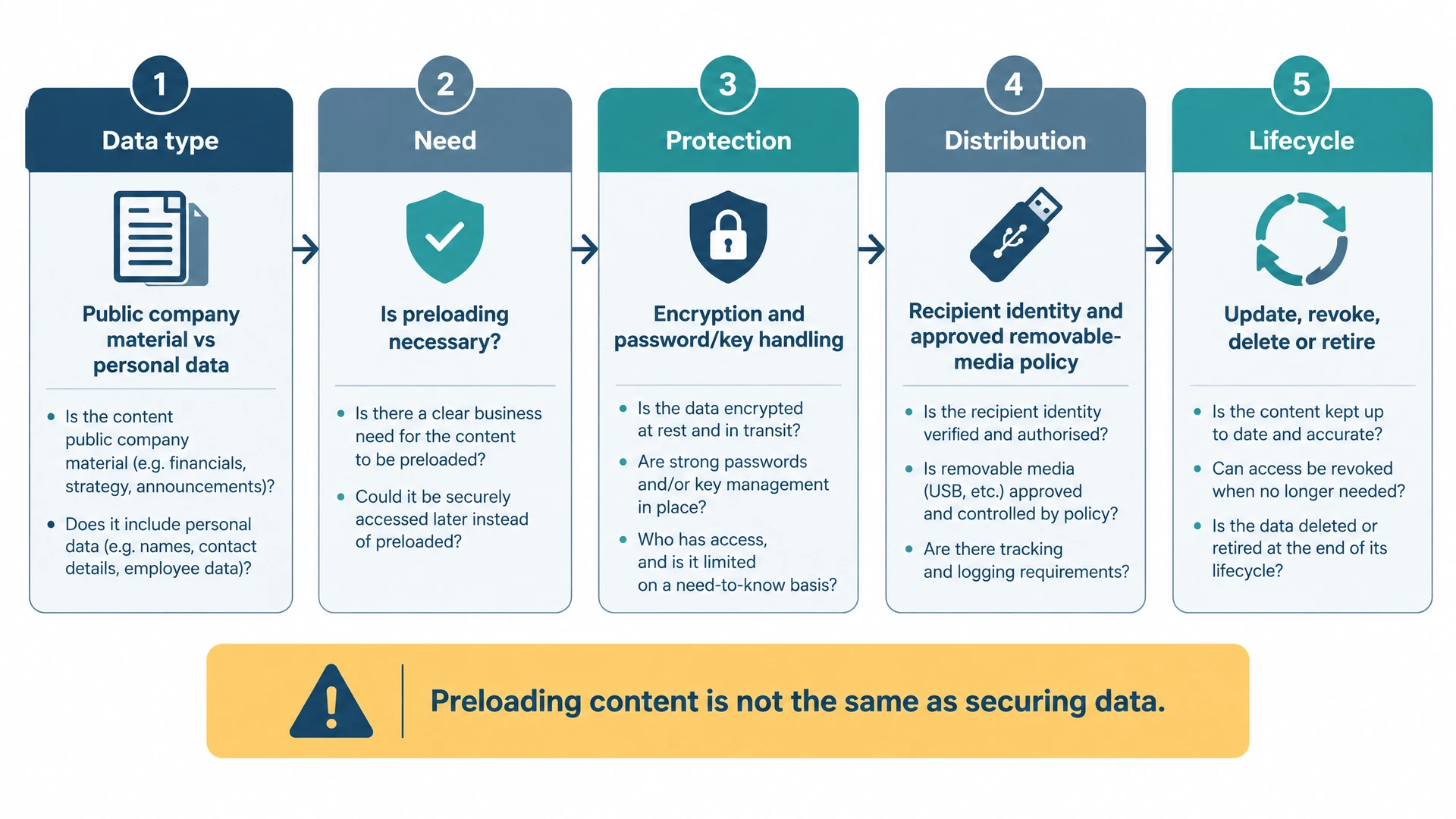
If the purpose is simply to give recipients access to a brochure, product catalogue or event programme, a QR code or controlled download page may provide stronger version control than a physical USB. A physical drive may still be appropriate when the audience has limited connectivity, needs offline files or expects a tangible technical resource, but that decision should be based on the recipient’s working environment rather than on the fact that a supplier offers data preloading as an option.
When personal data is genuinely necessary, the USB specification must be matched to the control model. A basic drive with a printed logo and a copied folder is not equivalent to an encrypted drive with a defined unlock process. The team must decide whether each recipient receives a separate access credential, whether one shared password is acceptable, who communicates it, how lost drives are reported, and whether access can be revoked. A password written on the same gift card as the drive may satisfy a superficial checklist while providing little protection if the package is lost together.
Encryption also creates a usability responsibility. A recipient who cannot open the content may copy it to an unprotected laptop, forward the password through an insecure channel or ask a colleague to bypass the intended process. The procurement decision should therefore consider the recipient’s technical capability, device environment and support route. A security feature that cannot be used reliably can move risk rather than remove it. The supplier may be able to install encryption software, but the buying organisation remains responsible for deciding how credentials, support and access rules operate in practice.
The NCSC’s guidance on using peripherals securely explains that external interfaces provide additional routes through which attackers may reach a device and the data it holds. It recommends balancing business need against security risk, setting a policy for peripheral connections, applying technical controls where possible and educating users about the risks. For organisations that manage laptops and phones through MDM, removable storage may be restricted, read-only or disabled altogether. This creates a direct procurement issue: a branded USB drive can be perfectly functional as a product and still be unusable for the recipients it was intended to serve.
That mismatch is common in employee welcome packs. A business may preload onboarding documents onto branded USB drives because it wants the pack to feel complete, but the recipient’s managed laptop may block external storage. The files then remain unopened, while the organisation has paid for a data-delivery method that conflicts with its own endpoint policy. The same problem can occur with clients in regulated sectors, where removable media is prohibited or must be scanned before connection. A more expensive encrypted drive does not automatically overcome a policy that forbids USB storage.
The distribution model affects the risk as much as the file itself. One hundred drives delivered to a single office under the control of an internal administrator create a different chain of custody from one hundred drives placed into delegate bags at a public event. Individual posting to home addresses introduces address accuracy, lost-parcel handling and recipient verification questions. Giving an unassigned drive to a visitor makes it difficult to establish who received which content. These details should be written into the brief before the supplier creates the preload package.
The same principle applies when different audiences receive different files. It is tempting to produce one master folder and copy it to every drive because that reduces production complexity. However, a single mixed audience can include employees, prospects, partners and event visitors with different permissions and different expectations. A client presentation may reveal information that is suitable for an existing customer but not for a prospect. A staff handbook may contain internal contacts or operational procedures that should not leave the organisation. Uniform production is not a substitute for correct audience segmentation.
Version control is another overlooked cost. If a product catalogue, price list or technical specification changes after the drives are produced, the organisation must decide whether the physical content should be recalled, whether a correction notice is sufficient, or whether the drive should be treated as obsolete. This becomes more difficult when the data was preloaded by a supplier without a retained manifest showing the exact files, hashes, version numbers and batch allocation. A reliable process should preserve a production record that identifies what was copied, when it was copied and which drive batch received it.
The supplier’s role should be defined narrowly and documented clearly. A supplier may copy an approved package, verify that the files open, report the number of drives processed and provide a sample for approval. That does not make the supplier the controller of the organisation’s data policy, the owner of the recipient permissions or the decision-maker for whether personal information should be distributed. If the supplier is given personal data or recipient lists, the organisation should obtain appropriate contractual and security assurances and avoid sending more information than is necessary for the fulfilment step.
The product category remains relevant. A USB drive with a metal casing and laser engraving may be appropriate for a durable client gift, while a compact plastic drive may suit a high-volume event. Capacity, USB interface, read/write speed and branding method affect the user experience, but none of those variables answers whether the preloaded content is safe. The broader business-needs framework is useful because it separates the choice of gift category from the operating conditions created by the gift. A technically attractive drive can still be the wrong delivery mechanism for a restricted data package.
A simple approval sequence prevents most of the avoidable errors. First, the content owner classifies the files as public, internal, confidential or personal-data-bearing. Second, the security or privacy owner confirms whether physical USB delivery is necessary and what protection is required. Third, IT or the recipient organisation confirms whether removable media is allowed and whether the expected devices can read the drive. Fourth, procurement selects the drive and branding specification that can support the agreed control model. Only then should the supplier receive the final preload package and production instruction.
The handover should leave an evidence trail rather than a verbal assurance. The buying team should retain the approved file manifest, the version date, the preload test result, the encryption or password method, the recipient model, the distribution responsibility and the process for reporting a lost drive. If the content is public and no personal data is involved, the evidence may be proportionate and simple. If personal data is involved, the documentation should reflect the higher risk and the organisation’s existing UK GDPR security procedures.
Preloaded branded USB drives work best when the content is stable, deliberately approved and genuinely useful offline. They work poorly when they are selected as a marketing extra after the product order is already fixed, especially when the files contain personal data or the recipients operate under strict removable-media controls. The procurement question is not merely whether a supplier can copy files onto a branded USB drive. It is whether that physical device is an appropriate, protected and supportable way to deliver the specific content to the specific audience.