Why Using Relationship Length to Choose a Corporate Gift Category Usually Gets It Wrong
Most procurement frameworks use how long a client relationship has lasted to determine gift category. The problem is that tenure and depth are not the same variable — and confusing them produces gifts that land badly in ways that are hard to diagnose.
Published by BritTech Works
There is a standard procurement shorthand that most teams use when they reach the gift selection stage: new clients get something introductory, long-term clients get something more substantial. The logic is intuitive. A relationship that has lasted four years presumably carries more weight than one that is six months old, and the gift should reflect that. This framework is so widely used that it rarely gets questioned. It feels like a reasonable proxy for relationship value, and it produces decisions that are easy to defend internally.
The problem is that it is measuring the wrong variable.
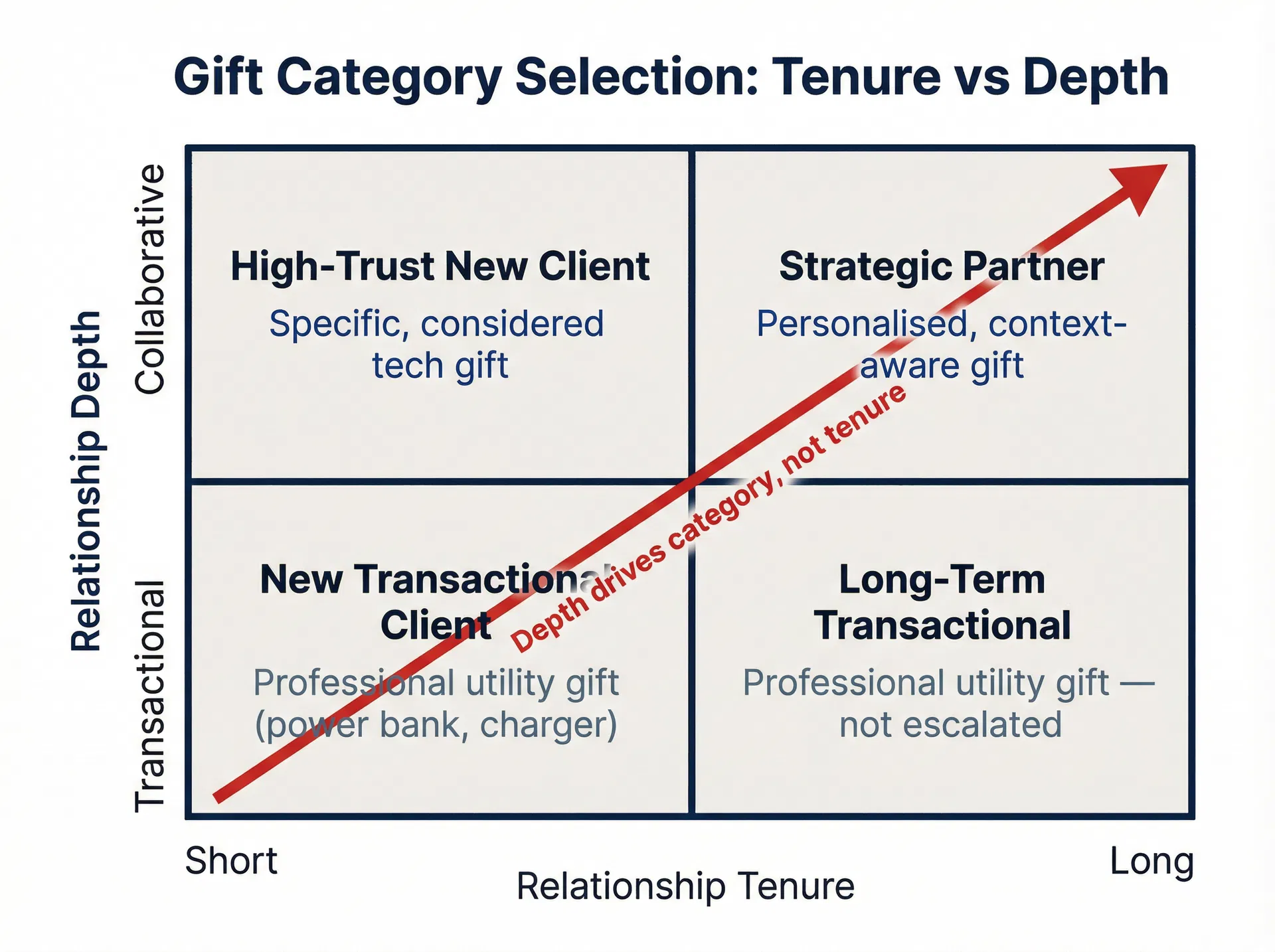
Relationship tenure — how long a client has been on the books — is a record-keeping fact. It tells you when the first contract was signed. It does not tell you anything about the nature of the interaction that has accumulated since then. A client who has been renewing an annual contract for three years without ever escalating beyond a standard account manager relationship is, in functional terms, a transactional client. A client who came on board eight months ago but has been deeply involved in co-development, has introduced two referrals, and has had substantive conversations with senior leadership is something entirely different. Treating these two relationships as equivalent because one is older is a category error that procurement frameworks rarely acknowledge.
This distinction matters because the gift category that works for a transactional relationship and the gift category that works for a high-trust relationship are not the same. For a transactional relationship — regardless of how long it has lasted — a branded tech gift like a custom power bank or a quality wireless charger functions well precisely because it is useful, professionally appropriate, and does not presume an intimacy that does not exist. It communicates competence and attention without overreaching. For a high-trust relationship, the same gift can feel like a missed opportunity, because the relationship has the depth to carry something more considered — perhaps a product that reflects a known preference, a specific use case the client has mentioned, or a configuration that acknowledges how they actually work.
In practice, this is often where the gift category decision starts to be misjudged. A procurement team working from a tenure-based framework will upgrade the gift for the three-year transactional client and send the same standard item to the eight-month high-trust client. Both decisions are wrong in different directions. The first produces a gift that feels disproportionate to the actual relationship dynamic — which can create awkwardness rather than goodwill. The second produces a gift that fails to acknowledge the genuine depth of the relationship — which can feel like a signal that the company is not paying attention.
The reason tenure gets used as a proxy for depth is straightforward: depth is harder to measure. There is no CRM field that captures whether a client relationship has moved from transactional to collaborative. There is no standard metric for how many substantive conversations have happened outside of formal contract reviews. Tenure, by contrast, is a number that every account management system can produce on demand. The ease of measurement creates a bias toward using it, even when it is not the most relevant variable for the decision at hand.
What makes this particularly relevant for tech gift categories is that the functional properties of different products map quite directly onto different relationship registers. A branded power bank is a professional utility item — it communicates that the sender understands the recipient's working life and has chosen something that will be genuinely useful. A custom wireless charging pad with a specific configuration is a more considered choice — it signals that the sender knows how the recipient works at their desk. Understanding which gift categories genuinely serve different business relationship needs requires separating the question of what the relationship has earned from the question of what the relationship actually is.
The practical correction is not complicated, but it requires procurement teams to add a second dimension to their selection framework. Alongside tenure, the relevant question is: what is the actual interaction pattern of this relationship? Has the client engaged beyond standard contract touchpoints? Has there been genuine collaboration, shared problem-solving, or mutual investment in outcomes? If the answer is no — regardless of how long the relationship has been active — the gift category should reflect a professional but not presumptuous register. If the answer is yes, the selection can carry more specificity and acknowledgment of the relationship's actual character.
The error that tenure-based frameworks produce is not dramatic. It does not usually result in gifts that cause offence or create obvious problems. What it produces instead is a quiet pattern of missed signals — gifts that are slightly off in ways that recipients notice without necessarily articulating. A long-term transactional client who receives an unexpectedly elaborate gift may wonder what the sender is trying to achieve. A high-trust client who receives the same standard item as everyone else may register, at some level, that the relationship is not being seen for what it is. Neither outcome is catastrophic. But neither is what a well-considered gift selection should produce.