Custom Branded Power Banks for Corporate Gifting in the UK: A Procurement Guide for Businesses Ordering in Bulk
A practical procurement guide for UK businesses evaluating custom branded power banks as corporate gifts — covering battery capacity selection, branding methods, MOQ, lead times, UKCA compliance, and supplier evaluation.
Published by BritTech Works Team
For UK businesses that order corporate gifts in volume, custom branded power banks have become one of the most consistently requested product categories — and for practical reasons. A power bank is used repeatedly, travels with the recipient, and keeps the brand visible in contexts that most promotional items never reach. The challenge is not finding a supplier willing to print a logo on a device. The challenge is understanding what the procurement process actually involves, where the decisions that affect quality and cost are made, and what a realistic timeline looks like from initial enquiry to delivery.
This guide is written for procurement managers, marketing teams, and business owners who are evaluating custom branded power banks as a corporate gift option and want to understand the full picture before committing to an order.
---
The appeal of a branded power bank is straightforward: it solves a problem that almost every professional encounters. Unlike branded pens or notepads, which are used briefly and discarded, a quality power bank becomes part of a recipient's daily carry. It goes to meetings, conferences, airports, and client sites. Every time it is used, the brand is visible — not just to the recipient, but to anyone nearby.
For UK businesses specifically, the combination of heavy mobile device usage and frequent travel makes power banks a particularly relevant gift category. A well-chosen device with a reliable battery capacity and a clean branded finish communicates that the sender understands the recipient's working life, rather than simply fulfilling a gifting obligation.
The key word in that sentence is "well-chosen." The range of products available in this category is enormous, and the difference between a device that reinforces brand quality and one that undermines it is not always visible from a product photograph or a price per unit.
---
Battery capacity is measured in milliampere-hours (mAh), and it is the specification that most buyers focus on first. The most common options in the corporate gifting range are 5,000 mAh, 10,000 mAh, and 20,000 mAh. Understanding what these figures mean in practice helps match the product to the recipient's actual needs.
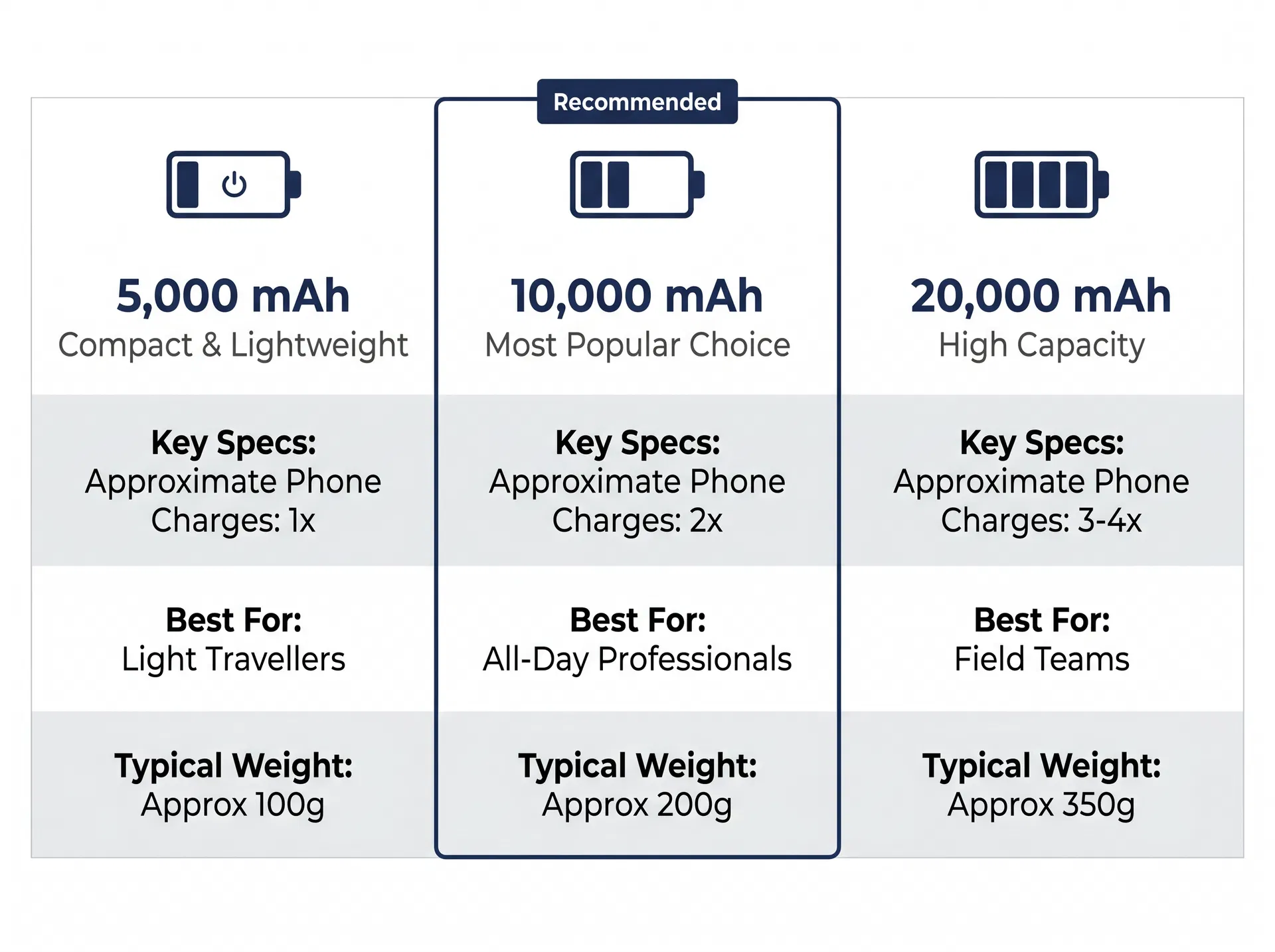
A 5,000 mAh device will typically provide one full charge for a modern smartphone. It is compact, lightweight, and easy to carry in a jacket pocket or small bag. For recipients who travel light and use their phone as their primary device, this is a practical and proportionate choice.
A 10,000 mAh device provides approximately two full charges for a smartphone, or a partial charge for a tablet. It is the most versatile option in the range — large enough to be genuinely useful across a full day of travel, small enough to carry without inconvenience. This capacity is the most commonly ordered in corporate gifting programmes because it balances utility with portability.
A 20,000 mAh device is a high-capacity option suited to recipients who work extensively from mobile devices or who travel internationally. It is heavier and bulkier than the lower-capacity options, which makes it less suitable as a standard corporate gift but appropriate for specific recipient groups such as field sales teams or executives with intensive travel schedules.
The capacity figure alone does not determine the quality of the device. Conversion efficiency — the percentage of stored energy that is actually delivered to the connected device — varies significantly between manufacturers. A low-quality 10,000 mAh device may deliver less usable charge than a high-quality 8,000 mAh device. When evaluating suppliers, asking about conversion efficiency and requesting test data is a more reliable indicator of real-world performance than the headline capacity figure.
---
The most visible customisation on a branded power bank is the logo or design applied to the outer casing. The method used to apply that branding affects both the appearance and the durability of the finished product, and the options available depend on the material and finish of the device.
Laser engraving removes the surface material to reveal the substrate beneath, creating a permanent mark that does not fade or peel. It is best suited to metal-cased devices and produces a clean, premium result. The limitation is that it is typically single-colour — the engraved area takes on the colour of the underlying material rather than a printed colour.
UV printing applies ink directly to the surface using ultraviolet light to cure it instantly. It supports full-colour designs and is suitable for both plastic and metal surfaces. The result is visually striking and can reproduce complex artwork accurately. Durability is good but not equivalent to laser engraving — UV-printed surfaces can show wear over time with heavy use.
Silkscreen printing is the most common method for high-volume orders. It applies ink through a mesh screen and is cost-effective for designs with a limited number of colours. It is less precise than UV printing for complex artwork but produces consistent results across large batches.
Beyond the logo application, some suppliers offer additional customisation options: custom packaging (individual boxes with branded inserts), custom cable colours, and custom boot screens on devices with digital displays. Each of these adds to the unit cost and, in some cases, to the lead time. Understanding which elements are genuinely valued by the recipient group — and which are primarily for the sender's benefit — helps prioritise where customisation budget is best spent.
---
For businesses ordering custom branded power banks in the UK, minimum order quantities (MOQ) are one of the first practical constraints to understand. The MOQ for a given product reflects the economics of the production process rather than an arbitrary threshold set by the supplier.
Custom branding requires setup work — creating screens for silkscreen printing, programming laser engraving parameters, or preparing UV printing files. This setup cost is fixed regardless of the order size. At low volumes, the setup cost per unit is high, which makes small orders economically unviable for the supplier at a price point that is competitive for the buyer. As order volume increases, the setup cost is spread across more units, and the per-unit cost decreases.
For standard silkscreen or UV printing on an existing product design, MOQs in the UK market typically start at 50 to 100 units for entry-level products and 25 to 50 units for suppliers with more flexible production arrangements. For fully custom designs — where the physical form factor, casing colour, or internal components are specified by the buyer — MOQs are substantially higher, often starting at 500 units and frequently requiring 1,000 or more.
The practical implication for buyers is that the MOQ question should be asked early in the supplier evaluation process, alongside the question of what is included in the quoted price. A supplier quoting a low per-unit price with a high MOQ may represent a higher total commitment than a supplier with a higher per-unit price and a lower MOQ, depending on the volume actually required.
---
Lead time is consistently the area where corporate gifting procurement goes wrong. The figure quoted by a supplier at the enquiry stage — typically expressed as a number of working days — is almost always the production lead time: the time from order confirmation and artwork approval to goods ready for dispatch. It does not include the time required to finalise artwork, complete the approval process, arrange shipping, or clear customs if the goods are manufactured overseas.
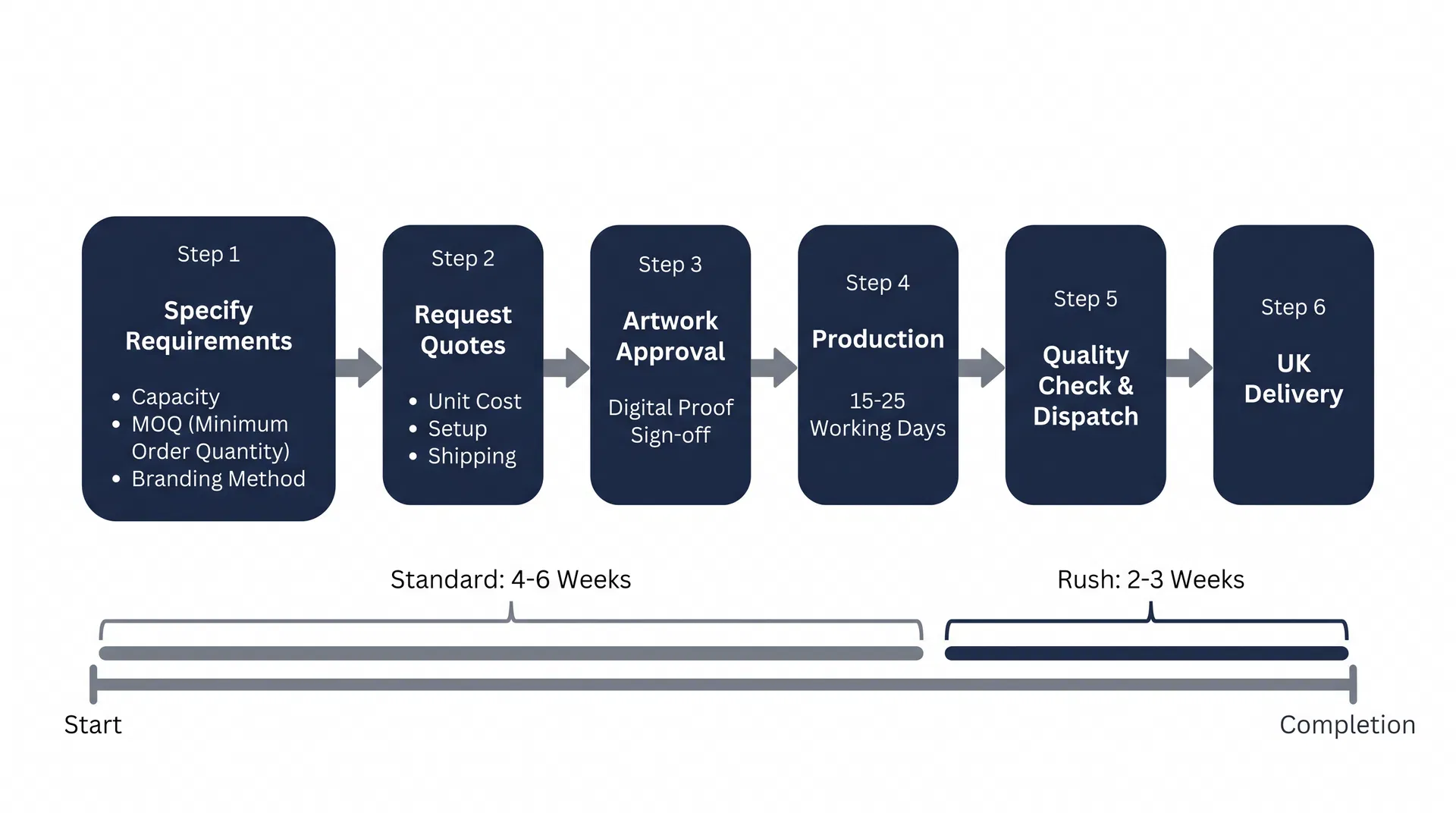
For custom branded power banks sourced from UK-based suppliers with domestic stock, lead times can be as short as five to ten working days from artwork approval. For products manufactured to order in Asia — which covers the majority of fully custom or high-volume orders — the production lead time alone is typically fifteen to twenty-five working days, with shipping adding a further two to four weeks depending on the method used.
The artwork approval process is a frequently underestimated variable. Most suppliers require a signed-off digital proof before production begins. If the buyer's artwork requires modification — because the file format is incorrect, the resolution is insufficient, or the design does not fit the available print area — each revision cycle adds time. Buyers who have their artwork prepared and approved before placing the order consistently receive their goods earlier than those who treat artwork preparation as a post-order task.
For orders with a fixed delivery deadline — a conference, a product launch, a seasonal gifting window — working backwards from the required delivery date to identify the latest possible order date is essential. Building in a buffer of at least five working days beyond the supplier's quoted lead time is a reasonable precaution for first-time orders with a new supplier.
---
Power banks sold or distributed in the UK are subject to the UK Conformity Assessed (UKCA) marking requirement, which replaced the CE marking for products placed on the UK market after the end of the Brexit transition period. UKCA marking indicates that the product meets the relevant UK product safety regulations, including the Electrical Equipment (Safety) Regulations 2016 and, for lithium battery products, the relevant provisions of the Dangerous Goods regulations for transport.
For buyers, the practical implication is straightforward: any power bank distributed to UK recipients should carry a valid UKCA mark, and the supplier should be able to provide documentation confirming compliance. This is not a bureaucratic formality. Power banks that do not meet the relevant safety standards present a genuine risk — lithium batteries that are poorly manufactured or inadequately protected can overheat, and in rare cases, can cause fires.
Reputable UK suppliers will have UKCA documentation available as a standard part of their product information. If a supplier is unable to provide this documentation on request, that is a significant indicator that the product may not meet the required standards, regardless of what the product listing states.
For businesses distributing gifts internationally — to recipients in EU countries, for example — CE marking is required separately. UKCA and CE are not interchangeable, and a product carrying only UKCA marking is not legally compliant for distribution in EU member states.
---
The UK market for custom branded power banks includes a wide range of suppliers, from large promotional merchandise companies with broad product catalogues to specialist electronics suppliers focused specifically on tech gifts. Price per unit is the most visible differentiator, but it is rarely the most important one for buyers whose primary concern is the quality and reliability of the finished product.
The questions that most reliably distinguish suppliers are: Can they provide samples of the specific product before the order is placed? Can they provide UKCA compliance documentation? What is their process for handling quality issues discovered after delivery? How do they manage artwork approval, and what is their policy if production errors are attributable to their own process?
A supplier who can answer these questions clearly and without hesitation is demonstrating that they have handled these situations before and have established processes for managing them. A supplier who deflects or provides vague answers to these questions is indicating that the post-order experience may be more complicated than the pre-order conversation suggests.
For businesses placing their first order with a supplier, requesting a pre-production sample — a physical unit produced with the actual branding applied — before committing to full production is a reasonable precaution. Most suppliers will accommodate this request, though it adds time to the overall process and typically incurs a sample fee.
---
The total cost of a custom branded power bank order includes more variables than the per-unit product price. Packaging — whether standard polybag, individual gift box, or custom-designed presentation packaging — adds to the unit cost and is often quoted separately. Artwork setup fees, if applicable, are typically a one-time charge per design rather than a per-unit cost. Shipping costs depend on the volume, the origin of the goods, and the delivery method.
For a realistic budget estimate, buyers should request a fully itemised quote that includes: per-unit product cost at the required volume, packaging cost, artwork setup fees, shipping to the UK delivery address, and any applicable import duties if the goods are manufactured overseas. Comparing quotes on a total-cost basis rather than a per-unit basis produces a more accurate picture of the actual commitment.
For UK businesses, custom branded power banks from reputable suppliers typically range from £8 to £25 per unit at volumes between 100 and 500 units, depending on capacity, build quality, branding method, and packaging. Products at the lower end of this range are suitable for high-volume distribution where cost per unit is the primary constraint. Products at the upper end are appropriate for client-facing gifts where the quality of the item reflects directly on the brand.